Today, we are excited to announce the release and open‑sourcing of ArenaRL, a novel comparative reinforcement learning (RL) method designed specifically for open‑ended agents. Alongside the methodology, we are releasing the training framework and a comprehensive suite of benchmarks for full‑lifecycle evaluation.
As AI evolves from passive question‑answering to active problem‑solving, enhancing an agent’s planning and execution capabilities through Reinforcement Learning (RL) has become a focal point in the industry. While RL has demonstrated remarkable success in domains with verifiable outcomes—such as mathematics and code generation—it faces significant hurdles in open‑ended tasks like complex travel planning or deep market research, where no single “golden answer” exists.
To address this, we propose ArenaRL. By moving away from unstable absolute scalar scoring and introducing a Tournament Mechanism, ArenaRL derives robust reward signals through pairwise comparisons. Crucially, it utilizes an optimized Seeded Single‑Elimination topology to maintain computational complexity at a controllable linear level ($O(N)$), striking the optimal balance between performance and efficiency.
This method has already been validated in large‑scale, real‑world scenarios within Amap’s (Gaode Map) core business operations.
The Challenge: Discriminative Collapse in Open‑Ended Tasks
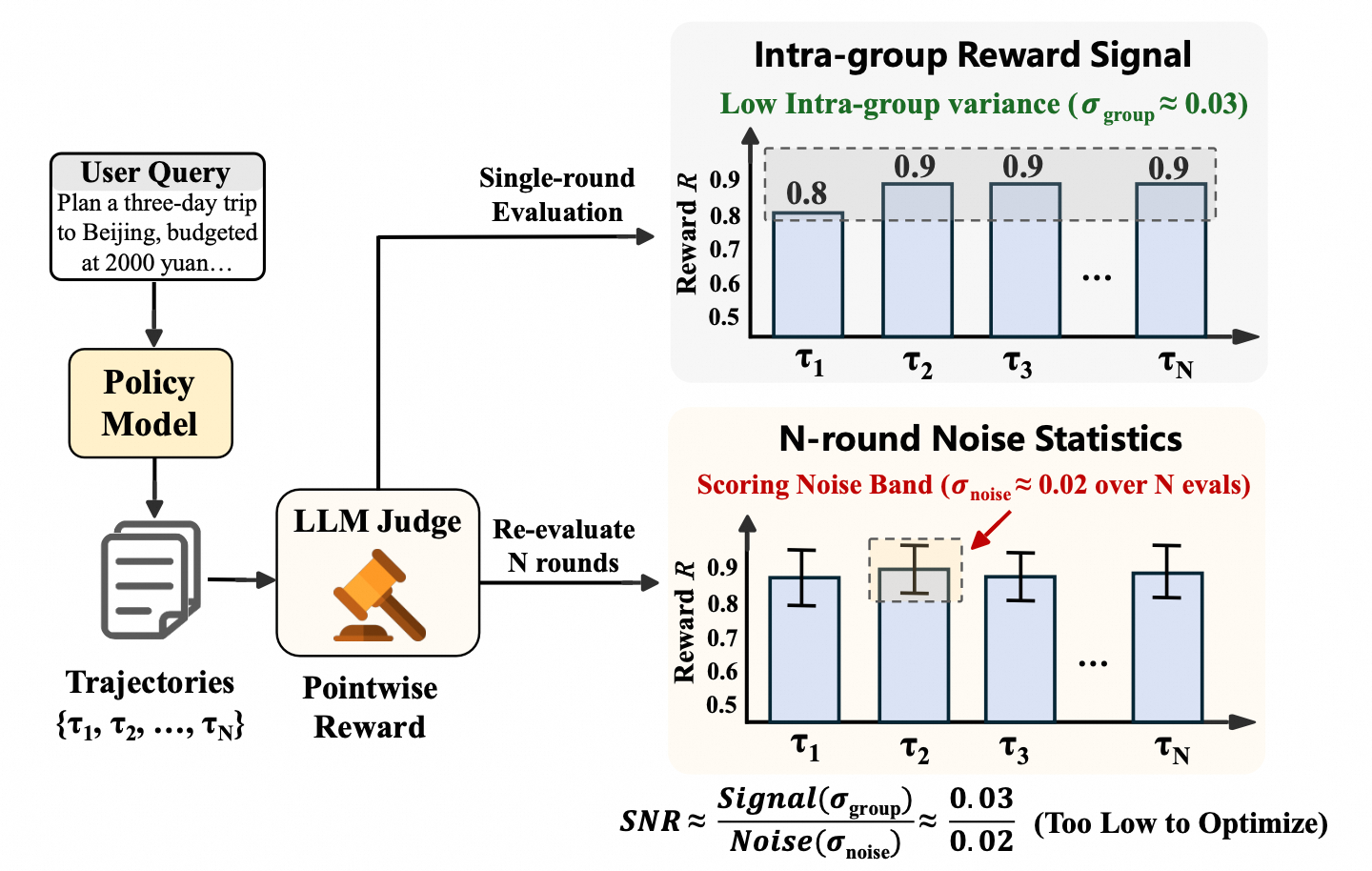
In open‑ended tasks—such as “Plan a cost‑effective family trip”—traditional RL paradigms typically rely on a Reward Model to assign an absolute scalar score (Pointwise Scoring) to each generated trajectory.
However, in practice, we identified a critical failure mode in this approach: Discriminative Collapse.
Absence of Objective Ground Truth: Open‑ended tasks are inherently subjective. Unlike math problems, it is difficult for a Reward Model to assign a precise, objective absolute score.
Signal Dominated by Noise: As the policy model improves, the quality of responses tends to converge (e.g., all scoring between 0.8 and 0.9). The Reward Model struggles to distinguish subtle differences between high‑quality responses. Consequently, random noise in the scoring process drowns out the true advantage signal, leading to stagnation or even degeneration during training.
Core Method: ArenaRL — Relative Ranking via Tournaments
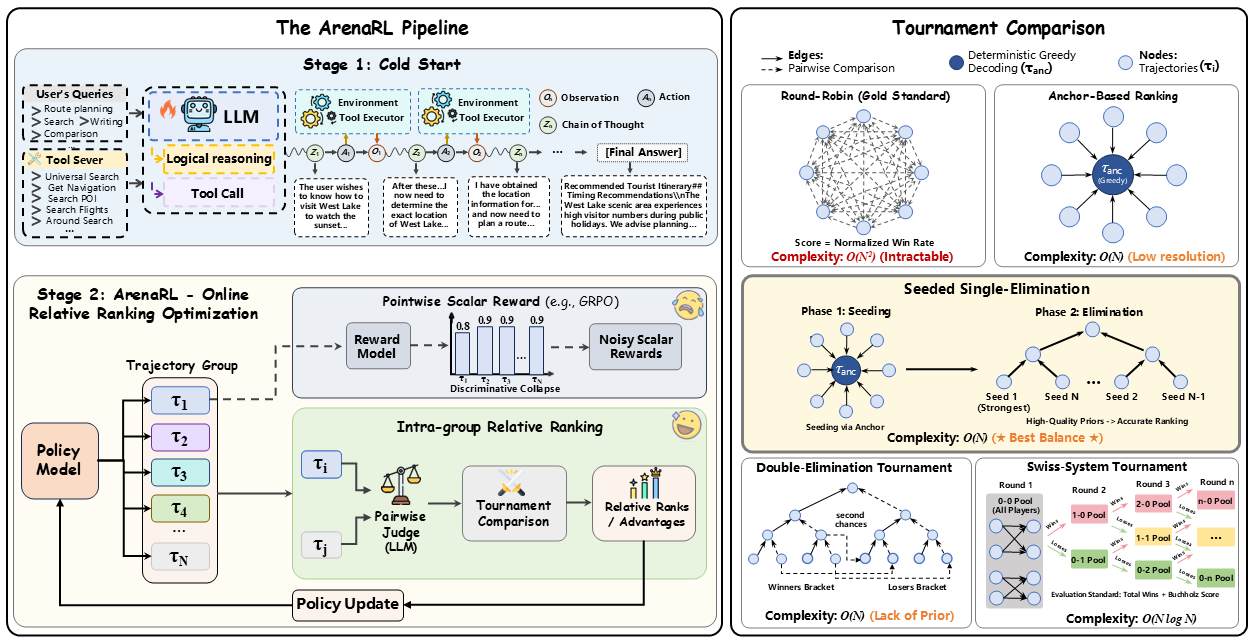
ArenaRL introduces a paradigm shift: moving from absolute scoring to intra‑group relative ranking. We constructed a multi‑dimensional evaluation arena to ensuring the model receives robust optimization signals even in complex open‑ended domains.
1. Evaluation Mechanism: Process‑Aware Pairwise Evaluation
The quality of an open‑ended agent depends not just on the final answer, but on the reasoning process. ArenaRL introduces a Process‑Aware evaluation mechanism that scrutinizes not only the outcome but also the logical tightness of the Chain‑of‑Thought (CoT) and the precision of Tool Use.
To mitigate Positional Bias when using LLMs as judges, we employ a bidirectional scoring protocol, ensuring that every “match” yields a fair and fine‑grained result.
2. Core Algorithm: Tournament‑Based Relative Ranking
ArenaRL generates a group of candidate responses for a single query, creating an “arena.” The model engages in self‑play, deriving relative advantage signals through pairwise comparisons.
This mechanism reframes reward modeling as an intra‑group relative ranking problem. Through quantile reward mapping, discrete rankings are converted into normalized Advantage Signals. Compared to absolute scores, relative ranking is inherently more robust to noise, capable of capturing subtle nuances between high‑quality trajectories and effectively circumventing “Discriminative Collapse.”
3. Topology Optimization: From Round‑Robin to Seeded Single‑Elimination
To find the sweet spot between efficiency and accuracy, we systematically compared various tournament topologies in our paper. The experimental data (based on the Open‑Travel benchmark) is shown below
| Topology | Comparison Cost | Avg. Win Rate |
|---|---|---|
| Anchor-Based | $N-1$ | 27.8 |
| Swiss-System | $N \log N$ | 28.3 |
| Double-Elimination | $2N-2$ | 30.2 |
| Seeded Single-Elimination | $2N-2$ | 32.5 |
| Round-Robin | $N(N-1)/2$ | 32.9 |
Based on these findings, ArenaRL adopts the Seeded Single‑Elimination architecture:
Anchor‑Based Seeding: We use a baseline trajectory generated via greedy decoding as a “quality anchor” to quickly pre‑rank candidates and establish seed positions. This prevents high‑quality samples from “colliding” and eliminating each other in early rounds.
Linear Elimination: A binary tournament tree is constructed based on the seed order.
Experiments demonstrate that this mechanism strictly controls computational complexity at a linear $O(N)$ level while achieving an advantage estimation accuracy that closely approximates the full Round‑Robin tournament.
Open Data: Full‑Lifecycle Benchmarks
The community currently lacks RL training and evaluation datasets specifically tailored for Open‑Ended Agents. To fill this gap, we have constructed and open‑sourced two major benchmarks: Open‑Travel and Open‑DeepResearch.
Open‑Travel (Co‑developed with Amap): Derived from real‑world travel scenarios, covering 5 typical tasks such as vague intent understanding, multi‑waypoint planning, and spatiotemporal constraint trade‑offs. It replicates the complex decision‑making environment of “multiple constraints, no standard solution.”
Open‑DeepResearch: Focuses on long‑horizon information retrieval and report generation, evaluating the agent’s ability in multi‑step tool invocation, information verification, and deep synthesis.
To support the reproduction of the ArenaRL training pipeline, we have released the Test Sets and the RL Training Sets (Prompts) for these benchmarks:
| Dataset | Domain | RL Training Set | Test Set |
|---|---|---|---|
| Open-Travel | Complex Travel Planning | 1,626 | 250 |
| Open-DeepResearch | Deep Info Retrieval | 2,216 | 100 |
| Total | 3,842 | 350 |
Experimental Results
We conducted extensive evaluations on Open-Travel, Open-DeepResearch, and general writing tasks. As shown below, ArenaRL achieves significant performance advantages over SFT baselines and traditional RL methods like GRPO and GSPO:
| Method | Open-Travel | Open-DeepResearch | General Writing |
|---|---|---|---|
| Closed-source Models | |||
| GPT-4o | 2.6 | 12.2 | 76.0 |
| Grok-4 | 16.8 | 34.8 | 84.7 |
| Gemini-2.5-pro | 10.6 | 28.3 | 85.4 |
| Claude-3.7-Sonnet | 31.6 | 19.1 | 76.6 |
| Fine-tuning & RL | |||
| SFT | 16.4 | 16.7 | 72.1 |
| GRPO | 16.4 | 25.2 | 73.6 |
| GSPO | 17.2 | 25.2 | 73.0 |
| ArenaRL (Ours) | 41.8 | 64.3 | 80.3 |
Analysis:
Complex Planning (Open‑Travel): In tasks involving vague intents and multi‑dimensional constraints, ArenaRL achieved a significant performance boost compared to SFT and traditional RL. This demonstrates that the tournament mechanism effectively incentivizes the model to escape local optima and explore superior planning strategies.
Long‑Horizon Tasks (Open‑DeepResearch): Traditional RL methods often produce unusable outputs due to “length bias” in long‑context tasks. ArenaRL improved the Valid Generation Rate to ~99%, effectively solving the instruction‑following challenge in long‑text scenarios.
General Writing: On three major general writing benchmarks, ArenaRL also performed exceptionally well, proving that the method possesses strong generalization capabilities beyond tool‑use agents.
Real‑World Application: Amap (Gaode Map)
ArenaRL has not only excelled in academic benchmarks but has also been successfully validated in Amap’s real‑world business scenarios. We evaluated it across two dimensions: Deterministic Search and Open‑Ended Planning.
Deterministic POI Search: In POI search tasks defined by explicit rules and intense competition, ArenaRL demonstrated extreme adaptability to rigid constraints. Compared to the baseline, search accuracy improved by 75% to 83%. This proves that even in deterministic settings, the tournament mechanism can keenly capture subtle quality differences, pushing performance beyond existing bottlenecks.
Complex Open‑Ended Planning: Addressing multi‑step reasoning tasks—such as “Find a quiet bar near the Bund with a river‑view terrace for a date” or “Inter‑city travel with luggage and time constraints”—the core business metric rose from 69% to 80%. The model exhibited stronger logical consistency, effectively handling vague user intents and making optimal trade‑offs between multiple constraints (time, cost, preference), significantly enhancing user satisfaction in complex tail scenarios.
System Architecture & Ecosystem
To empower the developer community, we have simultaneously open‑sourced the RL training/test data and the qqr training framework. qqr is a lightweight, non‑intrusive extension library built on slime, designed specifically for open‑ended agent training.
ArenaRL Algorithm: Full implementation of the core algorithms described in the paper. It includes built‑in topologies for Anchor‑Based, Round‑Robin, Swiss‑System, Double‑Elimination, and Seeded Single‑Elimination tournaments.
Designed for Open‑Ended Agents: Specifically engineered to tackle discriminative collapse in complex, open‑ended tasks, ensuring continuous policy improvement via relative ranking even when reward model scores stagnate.
MCP Support: Seamlessly integration with the MCP standardizes the decoupling of LLM inference and tool environments. Developers can reuse existing MCP Servers as training environments without rewriting interfaces.
High‑Performance Training: Built on top of
slimeto deliver high‑throughput, distributed rollout generation and training for large‑scale agent evolution.
We hope ArenaRL provides the community with a practical methodology for agent evolution, propelling us from Imitation Learning toward a broader era of Self‑Evolution.